Photovoltaic devices that are efficient and durable: Given the worldwide energy concerns and ample availability of solar energy, innovations in solar energy conversion are necessary to make solar photovoltaic a viable power source. Specially, the III-nitride materials system has properties which make it an excellent candidate for high efficiency photovoltaic devices.
For instance, the band gap of the GaInN materials system spans nearly the entire solar spectrum (0.7–3.4eV), creating the potential for making multi-junction solar cells with a single ternary alloy system. Moreover, the absence of other mature materials with a direct band gap greater than 2.2eV means that III-nitride materials hold great potential for use as the high energy cell in a multi-junction solar cell.
III-nitride solar cells would also be suitable for concentrator photovoltaic (CPV) applications if it is well understood how III-nitride solar cells respond to elevated operating temperatures
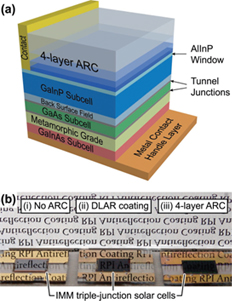
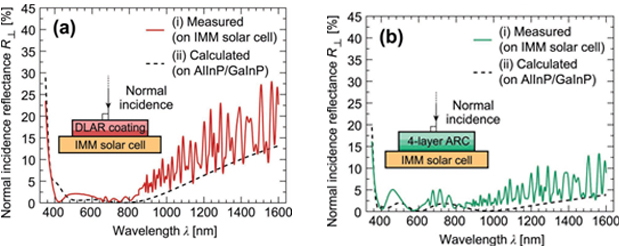
Therefore, in this field of the research topic, I would like to research the multi-junction III-nitride photovoltaic devices with epitaxial growth, fabrication, and device analysis. Furthermore, in order to harness the full spectrum of solar energy, optical reflections at the surface of a solar photovoltaic cell must be reduced as much as possible over the relevant solar spectral range and over a wide range of incident angles. The development of antireflection coatings embodying omni-directionality over a wide range of wavelengths is challenging.
Recently, nanoporous films, fabricated by oblique-angle deposition and having tailored-and very low-refractive index properties, have been demonstrated in my research group. Tailorability of the refractive index and the ability to realize films with a very low-refractive index are properties critical in the performance of broadband, omnidirectional antireflection coatings. As such, nanoporous materials are ideally suited for developing near-perfect antireflection coatings.
Starting on this understanding, I would like to expand the tailorability of the refractive index to other optoelectronic devices such as light-emitting diodes, photo detectors, and image sensors in order to enhance their optical efficiency.